AI Technology Trends 2026: The Biggest Developments Shaping the Future of Artificial Intelligence

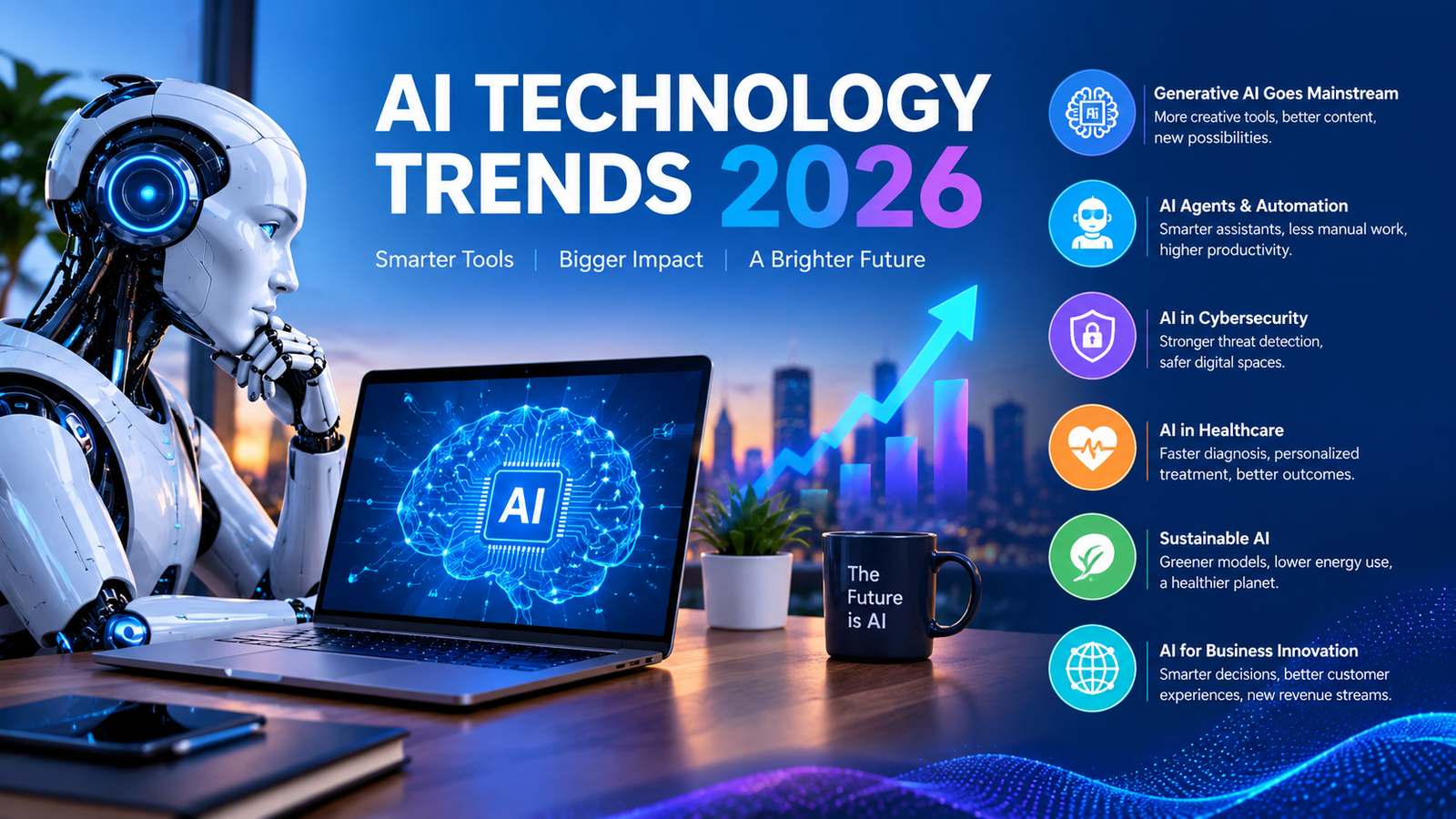
AI Technology Trends 2026 intelligence has moved beyond being a technology people simply experiment with. In 2026, AI is increasingly becoming part of the basic infrastructure behind businesses, software products, scientific research, smartphones, cybersecurity systems, factories, and everyday work. The conversation is no longer limited to whether companies should adopt AI. The bigger questions now involve how deeply AI should be integrated, how much autonomy it should receive, and how organizations can use it without creating new security, regulatory, or operational problems.
The pace of improvement is also difficult to ignore. Stanford University’s 2026 AI Index reports that AI capability is still accelerating rather than leveling off. More than 90% of notable frontier models produced in 2025 came from industry, while leading systems increasingly reach or exceed human baselines on challenging scientific, mathematical, coding, and multimodal reasoning benchmarks. Organizational AI adoption has also reached 88% among surveyed organizations.
However, the most important AI technology trends in 2026 are not simply about building a larger chatbot. The industry is shifting toward autonomous agents, multimodal interfaces, specialized models, physical AI, AI-native software development, stronger security systems, on-device intelligence, and enormous new computing infrastructure. At the same time, regulators and businesses are paying much closer attention to transparency and accountability. Here are the trends that matter most.
AI Technology Trends 2026 Agents Are Moving From Chatbots to Digital Coworkers
AI Technology Trends 2026 AI initially became popular because it could answer questions and produce content. In 2026, the industry is moving toward systems that can actually perform work. Agentic AI systems can receive a goal, plan several steps, interact with tools, retrieve information, execute actions, evaluate the results, and continue working until the task is completed.
The difference sounds simple, but it changes what AI can realistically do inside an organization. A chatbot might explain how to create a sales report. An AI agent could potentially collect the sales data, analyze performance, produce the report, update a dashboard, draft an email for the management team, and flag unusual results. Stanford’s 2026 AI Index shows how quickly agents have improved: performance on OSWorld, a benchmark involving real computer tasks, rose from roughly 12% to 66.3%. Still, agents fail around one-third of attempts on structured benchmarks, so completely unsupervised automation remains risky.
The next stage is multiagent AI. Instead of asking one system to handle an entire workflow, companies can assign specialized agents to research, planning, compliance, coding, customer support, or quality control. Gartner includes multiagent systems among its top strategic AI Technology Trends 2026 trends for 2026, arguing that groups of specialized agents can collaborate on complex workflows more effectively than one general-purpose system.
Multimodal AI Is Becoming the Normal AI Interface
AI Technology Trends 2026 -only artificial intelligence is rapidly becoming just one part of the market. Modern AI systems increasingly understand and generate several types of information, including text, images, audio, video, documents, computer interfaces, and sometimes real-world sensor data. This shift toward multimodal AI is making interactions with machines feel considerably more natural.
Imagine showing an AI a photograph of a damaged machine while explaining the problem verbally. Instead of requiring a carefully written prompt, the system can potentially inspect the image, understand the spoken description, compare the situation with technical documentation, and guide the user through troubleshooting. Similar multimodal experiences are becoming valuable in healthcare, education, customer service, engineering, design, and accessibility.
Multimodal reasoning is also improving rapidly at the frontier. Stanford’s 2026 AI Index notes that leading models now meet or exceed human baselines on several difficult multimodal reasoning evaluations. At the same time, the report warns that AI still has a remarkably uneven skill profile: systems can perform extremely difficult reasoning AI Technology Trends 2026 while failing at seemingly simple problems. This “jagged frontier” means impressive demonstrations should not automatically be mistaken for universal intelligence.
Domain-Specific and Smaller AI Models Are Becoming More Important
For AI Technology Trends 2026 years, much of the AI industry focused on building increasingly large general-purpose language models. That approach is not disappearing, but businesses are discovering that the biggest model is not always the most practical one. A highly specialized system can sometimes perform a narrow task more accurately, privately, and cheaply.
This is why domain-specific language models are becoming one of the major AI technology trends of 2026. These models are trained, fine-tuned, or grounded around a specific industry or function. A financial-services model can understand specialized financial language and compliance requirements, while a healthcare-oriented model can focus on medical terminology and clinical workflows. Gartner predicts that more than half of generative AI models used by enterprises could be domain-specific by 2028.
Smaller models also have an economic advantage. Not every customer-service query needs a frontier-scale reasoning system running inside an enormous data center. Companies are increasingly building architectures that route easy tasks to efficient models and reserve more expensive models for complicated requests. That AI Technology Trends 2026 AI systems faster, cheaper, and potentially easier to deploy within regulated environments.
AI-Native Software Development Is Changing How Applications Are Built
Software development may be one of the industries experiencing the fastest AI-driven transformation. Coding assistants have already become common, but 2026 is moving beyond simple autocomplete. AI development systems increasingly help create application architecture, generate tests, identify bugs, explain unfamiliar codebases, produce documentation, and implement entire features.
The technical improvements are substantial. Stanford’s 2026 AI Index reports that performance on SWE-AI Technology Trends 2026 Verified, a benchmark designed around real software engineering problems, increased from around 60% to nearly 100% within a year. That does not mean AI can independently manage every real production codebase, but it demonstrates how quickly automated programming capabilities have advanced.
Gartner describes AI-native development platforms as another major strategic trend for 2026. The broader idea is that developers increasingly describe the desired behavior of software while AI handles more of the implementation. Over time, smaller engineering teams may be able to build products that previously required far more people. Human engineers will still matter, particularly for architecture, security, testing, AI Technology Trends 2026 ent, and difficult technical decisions, but the unit economics of software production are clearly changing.
On-Device and Edge AI Are Bringing Intelligence Closer to Users
AI Technology Trends 2026 remains enormously important, but sending every request to a remote data center is not always ideal. It can create latency, privacy concerns, connectivity requirements, and ongoing inference costs. As processors inside phones, computers, vehicles, cameras, and other devices become more capable, more AI workloads are moving directly onto the hardware people use.
On-device AI is particularly attractive for privacy-sensitive applications. A device may be able to summarize private documents, analyze personal information, recognize speech, or organize local files without transmitting all of that data to an external server. Local execution can also allow certain AI features to continue working when internet connectivity is unavailable.
The AI Technology Trends 2026 industry is increasingly designing processors specifically around this future. Qualcomm, for example, has described new mobile neural processing architectures optimized for agentic AI, including running specialized models directly on devices. The broader trend extends well beyond one chipmaker: NPUs and other dedicated AI accelerators are becoming standard components across modern computing devices.
Physical AI Is Moving Intelligence Into Robots and Machines
One of the most significant AI technology trends in 2026 involves taking artificial intelligence out of screens and putting it into the physical world. Physical AI refers to systems that can perceive their environments, reason about what is happening, and take actions through robots, vehicles, drones, industrial equipment, and other machines.
The potential applications are enormous. Warehouses can use intelligent robots that adapt to changing inventory layouts. Factories can deploy machines capable of inspecting products and adjusting operations automatically. Agricultural systems can use computer vision and autonomous equipment to monitor crops. Logistics companies can combine sensors, robots, and AI planning systems to improve transportation and warehouse operations.
However, robotics remains far more AI Technology Trends 2026 than impressive demonstrations sometimes suggest. Stanford’s 2026 AI Index reports that robots succeed in only around 12% of real household tasks even while achieving much stronger results in controlled simulations. Autonomous vehicles are further along in specific environments, with large-scale driverless services expanding in the United States and China. The gap between controlled conditions and unpredictable real life remains one of physical AI’s biggest challenges.
AI Infrastructure and Inference Are Becoming a Major Competitive Battleground
The AI AI Technology Trends 2026 once focused heavily on training increasingly capable models. Training is still important, but inference—actually running models every time somebody uses them—is becoming an equally important economic challenge. When hundreds of millions of people and businesses repeatedly use AI services, efficiency at inference time can have an enormous impact on cost.
That is driving competition across GPUs, custom accelerators, memory, networking equipment, specialized inference chips, cooling systems, and data-center architecture. Gartner lists AI supercomputing platforms among the major strategic technologies for 2026, reflecting the increasingly complex combination of CPUs, GPUs, AI accelerators, memory systems, and orchestration software required to support modern workloads.
The infrastructure requirements are also becoming strategically important at a national level. Stanford reports that the United States hosts 5,427 data centers—more than ten times as many as any other country—while much of the world’s leading AI-chip fabrication remains heavily dependent on TSMC. This concentration is turning AI hardware and supply chains into issues of national competitiveness as well as AI Technology Trends 2026 strategy.
AI Security Is Becoming a Tech AI Technology Trends 2026 nology Category of Its Own
As AI systems AI Technology Trends 2026 more autonomous, protecting them becomes far more complicated. Traditional cybersecurity mainly focuses on users, applications, devices, and networks. Agentic AI introduces another actor: software that can independently access information and perform actions.
That creates new attack surfaces. Prompt injection can manipulate an AI into following malicious instructions. Poorly configured agents may expose private information or take unauthorized actions. Models may interact with compromised tools, while employees can unintentionally upload sensitive corporate data into external AI services. The larger the number of agents operating inside an organization, the harder monitoring becomes.
Gartner therefore lists dedicated AI security platforms among its major 2026 technology trends. These systems aim to AI Technology Trends 2026 centralized visibility, policy enforcement, monitoring, and protection against risks such as prompt injection, data leakage, and rogue agent behavior. Gartner expects more than half of enterprises to use AI security platforms to protect their AI investments by 2028.
AI Transparency, Provenance, and Regulation Are Becoming Practical Requirements
AI Technology Trends 2026 major change in 2026 is that AI governance is moving from theory into everyday product design. Governments are creating rules around transparency, high-risk AI, data use, automated decisions, and AI-generated content. Businesses can no longer treat governance as something to consider after an AI product has already launched.
The European Union provides one of the clearest examples. New AI Act transparency requirements began applying on August 2, 2026. Among other obligations, certain interactive AI systems must inform users that they are dealing with AI, while deepfakes and specified forms of AI-generated or altered material must be appropriately identified. Machine-readable marking also plays a role in making synthetic content easier to detect.
This creates growing demand for digital provenance—technology capable of helping people determine where content came from and whether it has been altered or generated by AI. Gartner includes digital provenance in its 2026 strategic technology trends alongside AI security. As synthetic text, images, audio, and video become harder to distinguish from authentic material, proving origin may become almost as important as generating the content itself.
AI Is Reshaping Work Rather Than Simply Automating Individual Tasks
Early AI Technology Trends 2026 about workplace AI often focused on whether a chatbot could save an employee a few minutes. In 2026, companies are increasingly examining entire workflows instead. The biggest productivity gains may come from redesigning how work happens rather than simply giving every employee an AI assistant.
This transition is still incomplete. McKinsey reported that nearly eight in ten companies were using generative AI, yet many had not seen significant bottom-line impact. One explanation is that general-purpose copilots deliver scattered productivity improvements while more transformative function-specific use cases often remain stuck at the pilot stage. The arrival of stronger agents is pushing organizations to rethink those workflows more aggressively.
The labor impact is becoming more visible as well. Stanford’s 2026 AI Index reports that employment among software developers aged 22 to 25 fell nearly 20% from 2024, while one-third of surveyed organizations expect AI to reduce their workforce during the coming year. Yet economy-wide evidence remains mixed, suggesting that AI’s effects are currently concentrated in particular roles, tasks, and entry-level hiring pipelines rather than appearing as uniform mass unemployment.
AI Is Becoming a Major Tool for Science and Medicine
Consumer chatbots receive most of the public attention, but some of AI’s potentially most important applications are AI Technology Trends 2026 inside laboratories. Artificial intelligence can help researchers analyze scientific literature, model biological structures, predict properties of materials, identify promising drug candidates, and explore enormous search spaces that would be extremely difficult to investigate manually.
The significance of the trend is reflected in Stanford’s 2026 AI Index, which now dedicates an entire chapter to AI in science, covering areas including biology, chemistry, physics, and astronomy. AI systems are increasingly becoming research instruments rather than merely tools for summarizing information.
Medicine is following a similar path. AI can assist with imaging, documentation, clinical decision support, drug discovery, and AI Technology Trends 2026 communication. Still, medical AI highlights why impressive benchmark results are not enough. Healthcare demands reliability, privacy, traceability, rigorous validation, and appropriate human oversight. In high-stakes environments, the future is likely to involve AI augmenting qualified professionals rather than simply removing them from the process.
Energy Efficiency Is Becoming a Core AI Engineering Problem
AI Technology Trends 2026 intelligence has created an unusual situation: individual AI tasks are becoming dramatically more efficient while total electricity demand from AI infrastructure continues to increase. Better chips, quantization techniques, smaller models, and more efficient software can reduce energy use per task, but people are also using AI far more frequently and for increasingly demanding workloads.
The International Energy Agency reported in 2026 that electricity consumption from AI-focused data centers increased by around 50% in 2025. The IEA also notes that demanding activities such as AI video generation, advanced reasoning, and agentic workflows may consume hundreds or thousands of times more energy per query than simple text generation, even as basic AI operations become much more efficient.
This means efficiency is becoming both an environmental and economic competitive advantage. Companies that can produce the same intelligence using fewer chips, less memory, and less electricity can dramatically reduce AI Technology Trends 2026 costs. In other words, the next AI breakthrough may not always be the model with the highest benchmark score. It could be the system that provides nearly the same quality at a fraction of the computational cost.
AI Adoption Is Becoming Global and Increasingly Competitive
Another notable trend in 2026 is how quickly AI adoption has spread beyond a handful of AI Technology Trends 2026 companies. Stanford estimates that generative AI reached approximately 53% population-level adoption within three years, faster than the early adoption curves of either the personal computer or the internet. Organizational AI adoption reached 88% in surveyed companies.
The competition between countries is changing as well. The United States remains dominant in private AI investment and produces many leading frontier models, but China’s model capabilities have moved remarkably close to those of the United States. Stanford reports that the performance gap between the leading U.S. and Chinese models had narrowed to only a few percentage points by early 2026.
At the same time, governments are increasingly concerned about AI sovereignty. Countries want greater control over computing infrastructure, data, models, chips, and cloud services rather than depending entirely on technoAI Technology Trends 2026 logy produced elsewhere. This is turning AI into an economic and geopolitical competition involving energy, semiconductor manufacturing, research talent, data centers, and regulation as much as algorithms themselves.
What the AI Technology Trends of 2026 Mean for Businesses
The biggest lesson for businesses is that simply purchasing an AI subscription is no longer an AI strategy. The organizations AI Technology Trends 2026 the most value are increasingly redesigning specific workflows around AI while deciding carefully which tasks should be automated, which should remain human-led, and where people and AI should work together.
Companies should also avoid assuming that every problem requires the most powerful available model. A practical AI architecture in 2026 may combine several technologies: small local models for private or repetitive tasks, specialized AI Technology Trends 2026 for industry-specific work, frontier models for complex reasoning, and AI agents for orchestrating actions across software systems.
Finally, governance needs to be designed at the same time as deployment. Identity management, permissions, monitoring, human approval points, data controls, security testing, and auditability become essential once AI moves from producing suggestions to taking actions. The more autonomous AI becomes, the more important clearly defined boundaries become.
Conclusion
The most important AI technology trends in 2026 show that artificial intelligence is moving into a new phase. The first wave of mainstream generative AI was dominated by chatbots capable of producing text and images. The current wave is about systems that reason, interact with multiple forms of information, operate software, collaborate as agents, and increasingly act in the physical world.
At the same time, the industry is discovering that raw intelligence is only one part of the equation. Cost, latency, reliability, privacy, security, energy consumption, provenance, specialized knowledge, and regulatory compliance are becoming just as important. That is why smaller models, domain-specific AI, on-device processing, dedicated security platforms, and efficient inference are growing alongside increasingly powerful frontier systems.
The overall direction is clear: AI is becoming less like a separate tool people occasionally open and more like a layer embedded throughout digital and physical systems. Businesses, developers, workers, and governments that understand that shift will be better prepared for what comes next. The winners of the AI era may not simply be those with access to the smartest model, but those who learn how to deploy intelligence safely, efficiently, and usefully at scale.
FAQs About AI Technology Trends 2026
What are the biggest AI technology trends in 2026?
The biggest trends include AI agents, multimodal AI, domain-specific models, AI-native software development, edge AI, robotics, and stronger AI security.
Are AI agents becoming more important in 2026?
Yes. AI agents are increasingly being used to complete multi-step tasks, interact with software tools, and automate business workflows with less human input.
How is multimodal AI changing technology in 2026?
Multimodal AI allows systems to understand and generate text, images, audio, video, and other data types, making AI interactions more natural and versatile.
Will AI replace jobs in 2026?
AI is automating certain tasks and changing some job roles, but many businesses are also using it to support employees rather than completely replace them.
Why is AI security important in 2026?
As AI systems gain access to sensitive data and automated actions, businesses need stronger protection against risks such as prompt injection, data leaks, and unauthorized AI activity.
Also Read: Free Things to Do in London