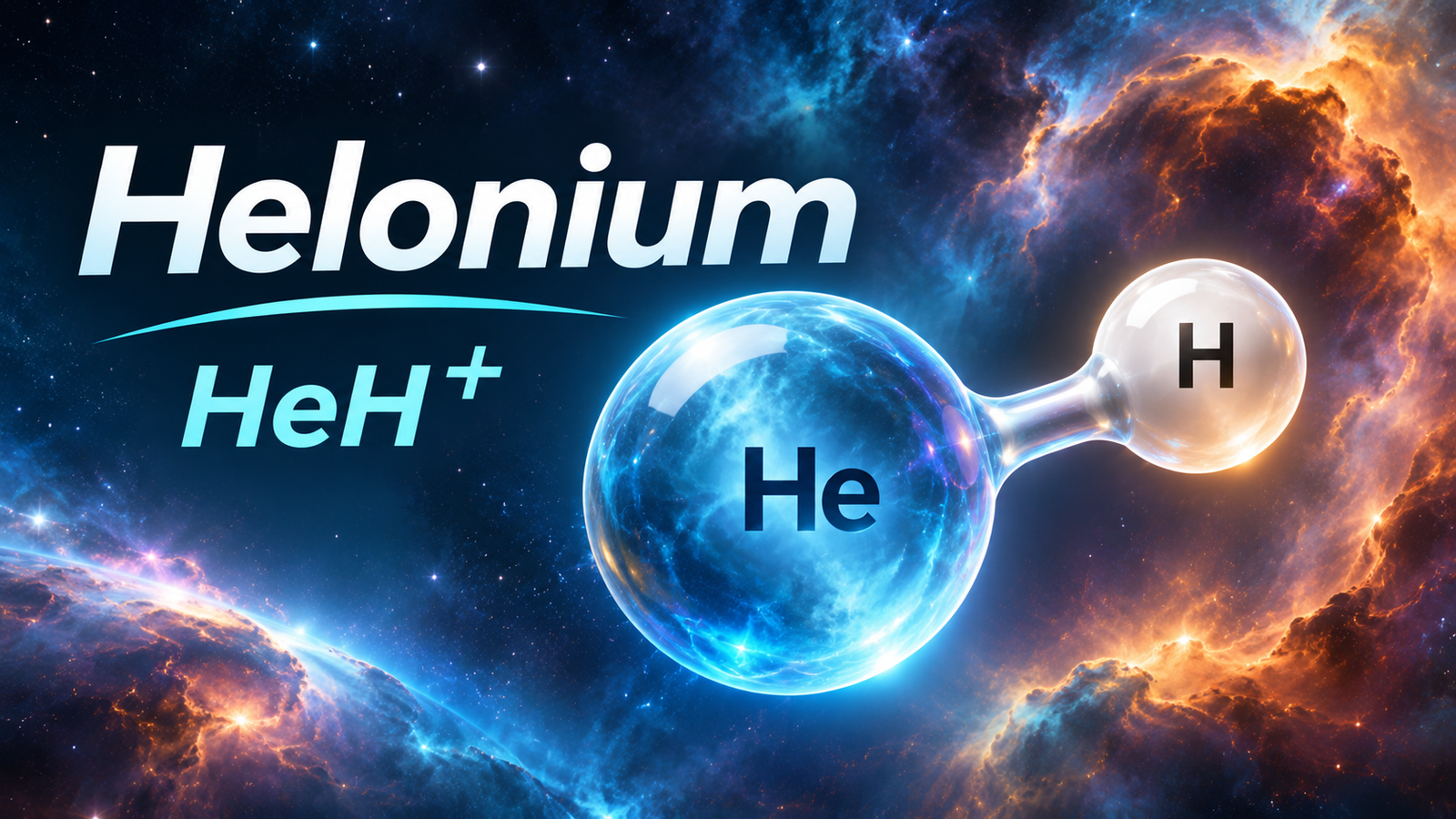
The Helonium is filled with fascinating substances, mysterious particles, and chemical compounds that continue to capture the attention of scientists. Among these remarkable discoveries is Helonium, an unusual chemical term connected to the earliest stages of cosmic development. Although it may sound like a newly discovered element, its scientific background is far more interesting than its name suggests.
Helonium is another name for the helium hydride ion, a positively charged molecular species consisting of helium and hydrogen. Its importance comes from its connection to the beginning of molecular chemistry in the universe. Scientists believe that this simple molecular ion played a significant role in the chemical processes that occurred long before stars, planets, and galaxies developed.
Understanding Helonium offers an exciting opportunity to explore chemistry, astronomy, molecular physics, and the history of the universe. From its laboratory discovery to its detection in outer space, this tiny molecular ion demonstrates how even the simplest chemical structures can help explain some of the biggest scientific questions.
What Is Helonium?
Helonium refers to the helium hydride ion, which is represented by the chemical formula HeH⁺. It contains one helium atom and one hydrogen nucleus, with an overall positive electrical charge. Although its structure is relatively simple, its chemical behavior makes it particularly interesting to researchers.
Unlike ordinary helium, which is generally unreactive under normal conditions, the helium hydride ion represents an unusual example of helium participating in a chemical bond. This challenges the simplified assumption that noble gases cannot form chemical bonds under any circumstances.
Helonium is not a separate chemical element and does not have its own position on the periodic table. Instead, it is a molecular ion formed from two different elements. While the name is relatively uncommon, its scientific identity is well documented under the more widely used name helium hydride ion. Word.ws+1
The Meaning and Origin of the Word Helonium
The name Helonium combines elements of the word helium with the chemical naming suffix “-onium.” Similar naming patterns can be found in terminology associated with positively charged chemical species, including ammonium and hydronium.
The structure of the word can easily create confusion among people who are unfamiliar with chemistry. Since many chemical elements have names ending in “-ium,” someone encountering Helonium for the first time might assume that it represents another element alongside lithium, sodium, or magnesium.
However, scientific terminology is more specific than these naming similarities suggest. Helonium describes a molecular ion rather than an individual element. In everyday language, the term remains relatively uncommon, while scientists generally prefer the chemical formula HeH⁺ or the name helium hydride ion when discussing research findings.
The Scientific History of Helonium
The scientific history of Helonium extends back to the early twentieth century. Researchers first identified the helium hydride ion in laboratory experiments in 1925. This discovery was particularly interesting because helium was already known for its limited tendency to participate in chemical reactions.
As scientists improved their understanding of atomic structures and molecular interactions, helium hydride became an important subject in theoretical chemistry. Researchers examined how its chemical bond formed, how it behaved under different conditions, and why it could not remain stable in most ordinary environments.
During the late 1970s, researchers began seriously investigating whether helium hydride could exist in astrophysical environments. Although theoretical studies supported the possibility, obtaining direct observational evidence proved difficult. The search eventually led to a major astronomical discovery in 2019. Nature
How Helonium Forms
The formation of Helonium involves an interaction between a neutral helium atom and a positively charged hydrogen nucleus. Under suitable conditions, these particles can combine to produce the helium hydride ion.
This process can occur through a mechanism known as radiative association. During the interaction, energy is released in the form of electromagnetic radiation, allowing the newly formed molecular ion to remain bound. The process requires specific physical conditions and is not something that typically occurs in everyday environments.
Temperature, particle density, radiation, and the availability of suitable reactants can influence the formation of Helonium. In astrophysical regions containing ionized gases, the necessary conditions may exist naturally. Understanding these conditions helps researchers identify environments where helium hydride might form and survive long enough to be detected.
The Chemical Structure of Helonium
Helonium has a relatively straightforward chemical structure compared with larger molecules. It contains two atomic nuclei and two electrons, making it a positively charged diatomic molecular ion. The term diatomic simply means that the molecular species contains two atoms.
Despite its simple composition, the interaction between its electrons and atomic nuclei involves important principles of quantum mechanics. Its chemical bond depends on the distribution of electrons and the attractive forces between charged particles.
Scientists study this structure to understand fundamental bonding behavior. Because helium hydride has relatively few particles, researchers can examine its properties using detailed theoretical calculations. These studies contribute to a broader understanding of molecular energy levels, chemical stability, and interactions between atoms.
Why Helonium Is Considered the First Molecular Ion
One of the most fascinating aspects of Helonium is its connection to the earliest chemical reactions in the universe. Shortly after the Big Bang, the universe was extremely hot, making it difficult for stable atoms and molecular structures to exist.
As the universe expanded and gradually cooled, conditions became suitable for electrons to combine with atomic nuclei. Helium became neutral before most hydrogen did, creating an environment in which neutral helium could interact with positively charged hydrogen nuclei.
Scientists believe that these interactions produced helium hydride roughly 100,000 years after the Big Bang. According to prevailing models of early cosmic chemistry, it was the first molecular species to form, marking an important transition from individual particles and atoms toward more complex chemical structures. Max Planck Institute for Radio Astronomy+1
The Role of Helonium in Cosmic Evolution
Cosmic evolution describes the physical and chemical changes that transformed the early universe into the complex environment observed today. Although Helonium was a simple molecular ion, its formation represented an important stage in this enormous process.
As the early universe continued to cool, helium hydride could react with neutral hydrogen and contribute to a sequence of reactions leading toward molecular hydrogen. Molecular hydrogen later became an important component of primordial gas and played a role in the development of the earliest stars.
This connection demonstrates why scientists devote considerable attention to seemingly insignificant molecular species. Helonium was not directly responsible for creating every structure in the universe, but it occupied an important position within the early chemical network that preceded more complex cosmic development.
The Groundbreaking Discovery of Helonium in Space
For decades, astronomers searched for direct evidence that Helonium existed beyond laboratory environments. Scientists had predicted its presence in certain astronomical regions, but detecting its extremely faint spectral signature presented considerable technical challenges.
On April 17, 2019, researchers published a study in the journal Nature announcing the successful detection of helium hydride in the planetary nebula NGC 7027. The discovery was achieved using specialized instruments aboard the Stratospheric Observatory for Infrared Astronomy, commonly known as SOFIA. PubMed
This achievement provided direct observational support for scientific predictions about helium hydride in space. Although the detected molecules were not surviving molecules from the early universe, their presence demonstrated that suitable modern astrophysical environments could produce this remarkable molecular ion.
Understanding the Connection Between Helonium and SOFIA
SOFIA was an airborne astronomical observatory developed through cooperation between NASA and the German Aerospace Center. It operated from a specially modified aircraft equipped with a large telescope and scientific instruments designed to observe the universe at infrared wavelengths.
One advantage of an airborne observatory was its ability to fly above much of the water vapor in Earth’s atmosphere. Atmospheric water vapor absorbs certain wavelengths of radiation, making some astronomical observations extremely difficult from ground-based telescopes.
Researchers used SOFIA’s GREAT instrument to identify the characteristic radiation associated with helium hydride at a wavelength of approximately 149.1 micrometers. This specialized measurement made it possible to distinguish the molecular ion’s signal from the surrounding astronomical environment. IRSA+1
The Importance of NGC 7027 in Helonium Research
NGC 7027 is a planetary nebula located in the direction of the constellation Cygnus. Despite its name, a planetary nebula is not necessarily connected to planets. It consists of material released by an aging star during the later stages of its development.
The central star within such a nebula can produce intense radiation that changes the chemical and electrical properties of surrounding gases. These environments may contain neutral atoms, positively charged ions, and other particles capable of participating in unusual chemical reactions.
NGC 7027 attracted scientific interest because researchers predicted that its physical conditions could support helium hydride formation. The successful detection of Helonium within this nebula demonstrated the value of combining theoretical chemical models with carefully selected astronomical observations. Nature+1
Key Physical and Chemical Properties of Helonium
Helonium possesses several distinctive properties that separate it from conventional gases and chemical substances. Its positive electrical charge is one of its defining characteristics, influencing how it interacts with surrounding particles.
Another significant property is its strong tendency to participate in proton-transfer reactions. The helium hydride ion is an exceptionally strong gas-phase acid and readily reacts with many other chemical species. This reactivity helps explain why it is difficult to maintain under ordinary conditions.
Helonium also possesses identifiable rotational and vibrational energy levels. These properties allow scientists to study it through spectroscopy, a technique involving the interaction between matter and electromagnetic radiation. Its spectral characteristics provide valuable information about its structure and potential presence in distant environments.
The Difference Between Helonium and Helium
People sometimes confuse Helonium with helium because of their similar names. However, these substances have fundamentally different chemical identities and behaviors.
Helium is a naturally occurring chemical element represented by the symbol He. It belongs to the noble gas family and has an atomic number of two. Under normal conditions, helium exists primarily as individual atoms and is valued for its low density and limited chemical reactivity.
Helonium, on the other hand, contains both helium and hydrogen and carries a positive electrical charge. It is considerably more reactive than ordinary helium and cannot be treated as a direct substitute for helium in practical applications. Recognizing these differences is essential when discussing chemistry or interpreting scientific information.
How Scientists Detect Helonium
Scientists frequently rely on spectroscopy to identify substances that cannot be directly collected or examined. Every molecular species has characteristic energy transitions that can produce or absorb radiation at particular frequencies.
By measuring these frequencies, researchers can identify the presence of specific molecules within distant astronomical environments. These measurements function somewhat like fingerprints, allowing scientists to distinguish one molecular species from another.
Detecting Helonium requires sensitive equipment because its emissions can be weak and difficult to separate from surrounding signals. Researchers must also account for atmospheric interference, instrument sensitivity, and other molecular emissions that may appear close to the expected frequency. Careful analysis reduces the likelihood of incorrect identification.
Helonium and Its Relationship With Quantum Mechanics
Quantum mechanics provides the foundation for understanding how atoms, electrons, and molecular structures behave at extremely small scales. Helonium offers a useful example because its relatively simple structure allows researchers to investigate fundamental molecular interactions.
Traditional descriptions of chemical bonding can explain general patterns, but quantum mechanics provides more detailed information about electron distribution, molecular energy, and the conditions required for stable bonding. These calculations are particularly valuable when studying unusual molecular ions.
Research involving helium hydride can help scientists compare theoretical predictions with experimental measurements. When these results agree, researchers gain greater confidence in the mathematical methods used to describe molecular systems. Such confidence becomes important when applying similar techniques to larger and more complicated chemical structures.
The Significance of Helonium in Astrochemistry
Astrochemistry is the scientific field that examines chemical substances and reactions occurring throughout the universe. Researchers study molecular clouds, stellar environments, planetary atmospheres, and other regions where chemical interactions take place.
Helonium holds a distinctive position within this field because of its connection to primordial chemistry. Studying this molecular ion allows researchers to explore chemical processes that differ considerably from those commonly observed on Earth.
Astrochemists also investigate how radiation, temperature, particle density, and electrical charge influence molecular formation and destruction. Helium hydride provides a valuable subject for these investigations because its presence depends strongly on environmental conditions. Its behavior helps researchers develop more accurate descriptions of chemical activity in space.
Does Helonium Have Practical Applications?
Unlike substances used in manufacturing, medicine, electronics, or energy production, Helonium does not have widely established commercial applications. Its highly reactive nature makes it unsuitable for conventional storage, transportation, or everyday use.
Its primary value lies in scientific research. Chemists and physicists can investigate helium hydride to improve their understanding of molecular bonding, reaction mechanisms, and the behavior of positively charged molecular species.
Helonium also has educational value because it demonstrates that even substances commonly described as chemically inactive can participate in bonding under particular circumstances. While its importance is mainly academic and experimental, the knowledge gained through studying it can support broader developments in fundamental science.
Common Misconceptions About Helonium
A common misconception is that Helonium represents a recently discovered chemical element. This is incorrect because helium hydride is composed of two existing elements rather than a unique type of atomic nucleus. It therefore does not require an additional position in the periodic table.
Another misunderstanding involves treating Helonium as a futuristic energy source or advanced industrial material. There is no established scientific evidence supporting such claims. Its documented importance relates primarily to molecular chemistry, astrophysics, and the study of cosmic history.
Some online discussions may also describe Helonium as a completely fictional expression. Although the name could be adopted creatively in games, novels, or fictional projects, it also has a documented chemical meaning. Separating verified scientific information from imaginative interpretations helps prevent unnecessary confusion.
The Challenges of Studying Helonium
Studying Helonium presents several challenges because of its reactive chemical nature. Unlike many stable compounds that can be stored in containers and examined repeatedly, helium hydride requires specialized conditions for its production and observation.
Astronomical research introduces additional difficulties. Scientists cannot easily collect samples from distant nebulae, so they must depend on radiation measurements and theoretical calculations. Weak signals, limited instrument sensitivity, and overlapping spectral features can complicate the identification process.
Researchers address these challenges through advanced laboratory equipment, computational simulations, and sensitive astronomical instruments. Combining different research methods allows scientists to compare results and develop stronger explanations of the molecular ion’s formation, behavior, and destruction.
Why Helonium Matters in Scientific Education
Helonium provides an interesting way to introduce students to several important scientific concepts. Its unusual chemical behavior encourages learners to move beyond simplified rules and examine how environmental conditions influence molecular interactions.
For chemistry students, helium hydride offers an opportunity to explore ionic charge, chemical bonding, acid behavior, and molecular energy levels. Physics students can examine its relationship with quantum mechanics, electromagnetic radiation, and spectroscopy.
Astronomy students can use Helonium as a starting point for understanding the early universe and the development of cosmic chemistry. By connecting these different subjects, the molecular ion demonstrates that scientific disciplines often work together to explain natural phenomena rather than operating independently.
The Future of Helonium Research
Future investigations into Helonium may improve scientific understanding of its formation, destruction, and abundance in different astrophysical environments. Researchers can examine additional regions of space to determine whether observations agree with existing chemical models.
Improvements in astronomical instruments and computational methods may also allow scientists to obtain more detailed information about molecular reactions. More precise measurements could help resolve uncertainties surrounding chemical reaction rates and the structure of regions where helium hydride forms.
Although Helonium is a relatively simple molecular ion, it continues to provide meaningful opportunities for scientific investigation. Its study reminds researchers that important discoveries do not always involve large celestial objects or complex substances. Sometimes, understanding a small molecular structure can help explain processes that occurred billions of years ago.
Conclusion
Helonium is a fascinating molecular ion with a remarkable connection to the chemical history of the universe. Scientifically known as helium hydride, it consists of helium and hydrogen with an overall positive electrical charge. Its unusual properties make it an important subject in chemistry, molecular physics, and astronomy.
From its laboratory discovery in 1925 to its confirmed astronomical detection in 2019, helium hydride has provided scientists with valuable insights into molecular bonding and cosmic chemical development. Its connection to the earliest stages of the universe makes it particularly significant for researchers investigating the origins of matter and astronomical structures.
Ultimately, Helonium demonstrates how even the simplest molecular species can have extraordinary scientific importance. As research methods continue to improve, studying helium hydride may help researchers build a more complete understanding of the chemical processes that shaped the universe we experience today.