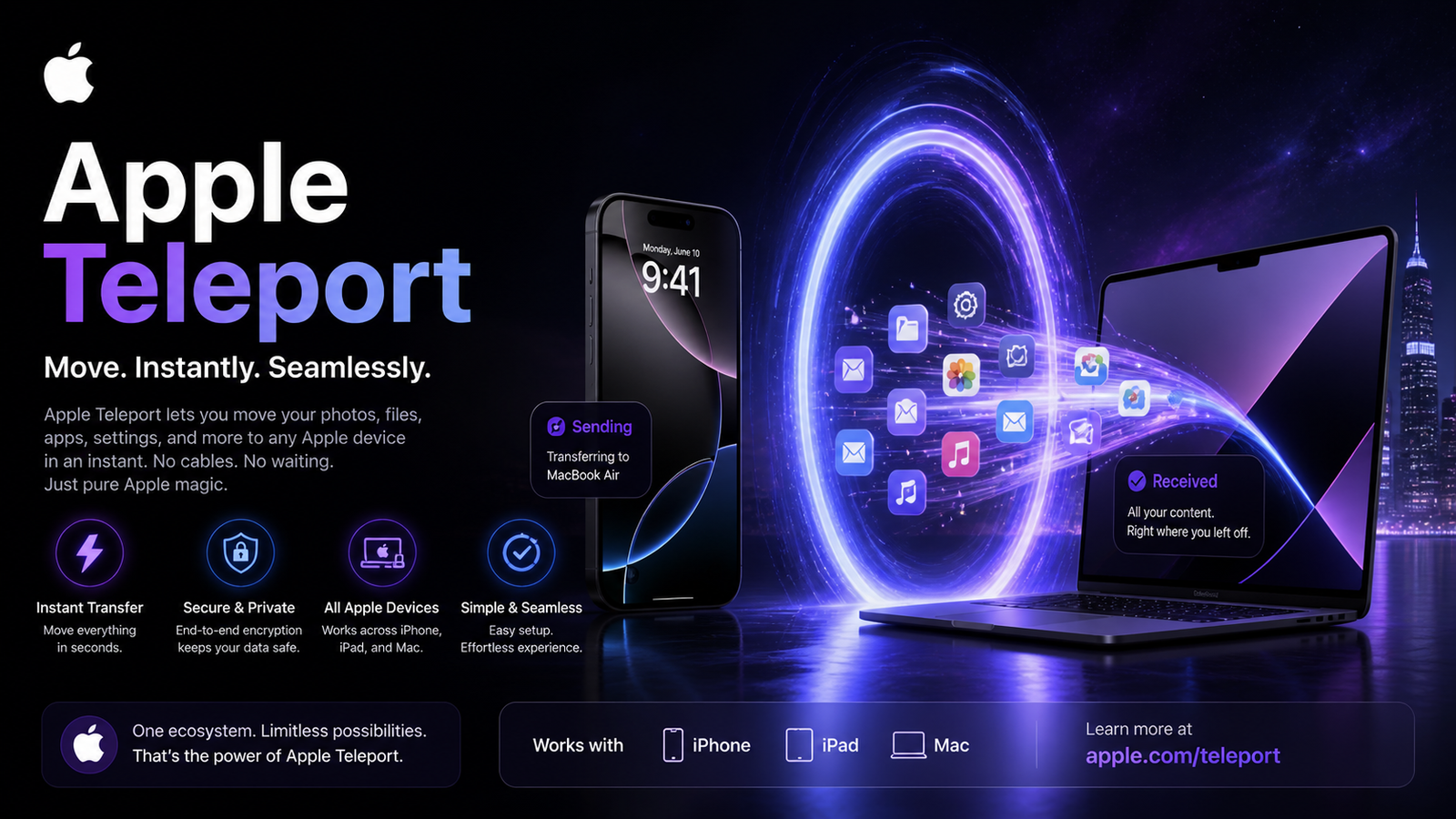
Apple Teleport sounds like the kind of futuristic product Apple would reveal on a dramatic stage: instant travel, immersive digital worlds, and a sleek device that feels straight out of science fiction. The name itself is powerful because it combines Apple’s reputation for premium technology with one of humanity’s oldest dreams: moving from one place to another instantly.
But here is the important truth: Apple Teleport is not an official Apple product. As of now, Apple has not announced a device or service called Apple Teleport. The phrase is mostly used online in rumors, concept videos, AI-generated posts, and speculative articles about what future Apple technology could look like.
That does not mean the topic is useless or fake in every sense. “Apple Teleport” has become an interesting keyword because it reflects how people imagine the future of travel, mixed reality, virtual presence, and spatial computing. Apple’s real product in this area is Apple Vision Pro, which Apple describes as a spatial computer that blends digital content with the physical world.
What Is Apple Teleport?
Apple Teleport is best understood as an online concept rather than a real Apple device. People use the term to describe a futuristic idea where Apple could create technology that makes users feel as if they are instantly transported to another place. In most discussions, it is connected to virtual reality, augmented reality, mixed reality, and immersive travel experiences.
The idea usually appears in two forms. The first is literal teleportation, where a person physically moves from one location to another instantly. That version is pure science fiction right now. The second version is digital teleportation, where technology makes you feel present somewhere else through screens, cameras, 3D environments, spatial audio, and realistic virtual spaces.
This second meaning is where the idea becomes more realistic. Apple already works in spatial computing through Apple Vision Pro, which allows users to interact with digital content in their physical space. Apple has also promoted Vision Pro for entertainment, work, memories, communication, and immersive experiences, which explains why people connect the “teleport” concept with Apple’s future.
Why Apple Teleport Became Popular Online

Apple Teleport became popular because it sounds believable enough to catch attention. Apple is known for turning complex technology into polished consumer products, so when people see a futuristic Apple-branded concept online, they may assume it is real. That is especially true when the content uses realistic product mockups, clean Apple-style design, or AI-generated videos.
Social media also plays a huge role. A short video showing someone “teleporting” with an Apple device can spread quickly, even if it is just editing. Many viewers do not stop to check whether the product exists. The result is a cycle where people search for Apple Teleport, creators make more content around it, and the keyword keeps growing.
There is also a psychological reason behind the trend. People want technology to solve physical distance. They want to attend meetings, visit places, explore destinations, or connect with others without travel costs, time delays, and fatigue. “Apple Teleport” captures that dream in a simple phrase, even though the real technology behind it is closer to spatial computing than actual teleportation.
Is Apple Teleport a Real Apple Product?
No, Apple Teleport is not a real Apple product at this time. Apple has official pages for products such as iPhone, Mac, iPad, Apple Watch, AirPods, and Apple Vision Pro, but there is no official Apple device called Apple Teleport. When Apple discusses immersive technology, the official term it uses is mainly spatial computing, especially around Apple Vision Pro.
Interestingly, Apple does have an official educational tutorial called “Make Someone Teleport,” but that is not a product. It is a creative video-editing lesson that teaches users how to create a teleportation effect using jump cuts and match cuts. In simple words, it is about making someone appear to vanish and reappear in a video, not about real transportation.
There is also an App Store app named “Teleport: 360° Camera,” but that is a separate app and not an Apple-made teleportation device. It focuses on capturing spherical 360-degree panorama photos using an iPhone. This shows how the word “teleport” is often used in tech branding, but it does not mean Apple has launched actual teleportation technology.
How Apple Vision Pro Connects to the Apple Teleport Idea
Apple Vision Pro is the closest real Apple product connected to the Apple Teleport concept. It does not teleport people physically, but it can make digital experiences feel more present, immersive, and spatial. Instead of looking at a flat screen, users can place apps, videos, photos, and environments around them in a three-dimensional space.
This is why people often connect Vision Pro with virtual travel. A person may not be able to instantly appear in Paris, Tokyo, Dubai, or New York, but immersive media can create the feeling of being somewhere else. With high-resolution displays, spatial audio, 3D content, and realistic environments, the experience can feel much deeper than watching a normal video.
Apple’s own description of Vision Pro focuses on blending digital content with the physical world. That is not teleportation in the scientific sense, but it is a step toward what many people emotionally mean when they say “digital teleportation.” It is about presence, immersion, and reducing the feeling of distance.
Could Apple Build Something Like Apple Teleport in the Future?
Apple could build more advanced immersive experiences in the future, but that does not mean physical teleportation is coming. A realistic future version of “Apple Teleport” would likely be a software or hardware experience built around spatial computing, lifelike avatars, real-time 3D environments, and virtual travel. It would help users feel present in another place without actually moving their bodies.
This future could include virtual tourism, remote education, business collaboration, medical training, real estate tours, concerts, sports events, and family communication. For example, instead of joining a video call, you might appear as a realistic spatial persona in a shared digital room. Instead of viewing a property through photos, you could walk through a full-scale 3D version of it.
Apple is already encouraging developers to build spatial apps for visionOS, the operating system for Vision Pro. Apple describes Vision Pro as offering an “infinite canvas” for spatial computing experiences, which gives developers room to create apps that feel far more immersive than traditional mobile or desktop software.
Benefits People Imagine from Apple Teleport
The biggest imagined benefit of Apple Teleport is convenience. Travel takes time, money, energy, and planning. A digital teleport-style experience could let people explore places, attend events, or collaborate with others from home. It would not replace every real-world experience, but it could reduce the need for unnecessary travel.
Another benefit is accessibility. Not everyone can travel easily because of health, disability, financial limitations, visa issues, family responsibilities, or work schedules. If immersive spatial technology becomes more affordable and realistic, it could give more people access to experiences that were previously out of reach.
There is also a strong business case. Companies could use teleport-like spatial tools for training, design reviews, remote meetings, and technical support. Apple has already highlighted business uses for Vision Pro, including customized workspaces, 3D design collaboration, employee training, and remote fieldwork guidance.
The Limitations of the Apple Teleport Concept
The main limitation is obvious: real teleportation does not exist as a consumer technology. No Apple device can move a person physically from one place to another instantly. Any online claim suggesting that Apple has launched a real teleportation machine should be treated carefully unless Apple officially confirms it.
The second limitation is hardware comfort. Immersive headsets still face challenges such as price, weight, battery life, content availability, and long-term comfort. Even if the experience is impressive, it needs to be practical for everyday use before it can become mainstream. This is one reason spatial computing is still developing rather than fully replacing phones, laptops, or travel.
The third limitation is realism. A virtual beach is not the same as feeling real sand, weather, smell, culture, and human atmosphere. Digital teleportation can support learning, previewing, entertainment, and communication, but it cannot fully replace the physical world. The best version of this technology will probably complement real life, not erase it.
Conclusion
Apple Teleport is not an official Apple product, but it is a powerful concept. It shows how people imagine the next stage of technology: not just faster phones or better screens, but deeper digital presence. The keyword became popular because it blends Apple’s futuristic brand image with the dream of instant movement and immersive experience.
The real Apple technology closest to this idea is Apple Vision Pro and the wider field of spatial computing. Vision Pro does not physically teleport anyone, but it does create a more immersive way to work, watch, connect, and experience digital spaces. That is why the “Apple Teleport” conversation continues to attract attention.
YOU MAY ALSO READ